I grew up reading science fiction. Isaac Asimov. Douglas Adams. Orson Scott Card. I read fantasy too — Piers Anthony was part of that early mix — and while I see the problems in some of that work more clearly now, I still recognize how deeply imagination shaped me. Those books taught me that stories didn’t have to stay close to the ground to tell the truth.
The same was true of what I watched. Star Trek, Star Wars, Quantum Leap, Sliders. These weren’t just stories about technology or alternate worlds — they were stories about people trying to figure out who they were, what they believed, and how to live with the consequences of their choices.
Star Wars stayed with me the most, not because of the spectacle, but because of the characters. They were flawed, uncertain, pulled in opposing directions. The setting was vast, but the conflicts were human. It wasn’t just a war in space — it was a story with heart.
So when I began working on my own book, the question wasn’t why science fiction. It was why anything else would have worked.
I could have written a straightforward account of my life as a musician — where I came from, where I went, what worked, what didn’t. But realism would have kept the story too close to the facts. Autobiography invites comparison, judgment, and explanation. It asks the reader to measure what happened instead of feel what it meant.
Science fiction gave me distance.
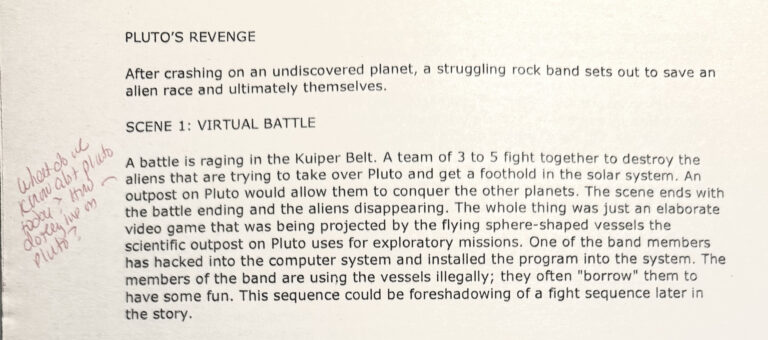
Pluto’s Revenge didn’t begin as my life wrapped in metaphor. I wasn’t trying to map events one-to-one. But when you write honestly, your experience shows up whether you intend it to or not. The themes that mattered to me — ambition, distance, disappointment, resilience — naturally found their way onto the page.
By placing the story on Pluto, I was able to exaggerate the emotional reality. The isolation. The obscurity. The sense of wanting to be seen from impossibly far away. Novan’s journey isn’t my journey in any literal sense, but the feelings that drive him are real.
Fiction also gave me freedom to tell more than one story. To create characters who struggle with values and conflicts that aren’t mine, but that I’ve watched others wrestle with over the years. It allowed the world to be larger than a single perspective, larger than my own experience.
My life has had difficult moments, but nothing on the scale of what Novan and his crew face. That distance matters. It lets the story breathe. It lets the emotions become clearer, not smaller.
In the end, science fiction wasn’t a genre choice. It was a necessity. It was the only way to tell the story without reducing it to facts, explanations, or defenses.
Some truths need space to be seen clearly.